Managing Pests in Apple Orchards
North Carolina’s hot and humid climate, and the more than three dozen apple tree insect and disease pests, make pest management for growers particularly challenging. For example, codling moth, harbinger of the "wormy" apple, can have as many as three generations in the south versus just two generations in cooler northern climates. In addition to relatively intense pest pressure, U.S. Environmental Protection Agency (EPA) restrictions under the Food Quality Protection Act (FQPA) prevent Henderson County apple growers from using certain chemical pesticides.
Making the switch to more management-intensive approaches is not easy for growers, particularly when keeping a business afloat in an era of historically low apple prices is already a challenge. New, reduced-risk insecticides are considered "narrow-spectrum," meaning they have less activity against beneficial organisms—or pest-predators—than older, more broad-spectrum materials. Narrow-spectrum insecticides allow growers to take greater advantage of biological—rather than chemical—control of pests. But these reduced-risk insecticides require intense monitoring of orchard conditions, as growers must keep abreast of the interaction between predators and pests to effectively time sprays.
 Nestled in the Blue Ridge Mountains, Henderson County is the heart of North Carolina’s apple country. In 2000, the Southern Appalachian Apple Integrated Pest Management Project was established to increase and support the adoption of Integrated Pest Management (IPM) across much of the County’s apple orchards. A key component of the effort has been the use of Environmental Quality Incentives Program (EQIP) incentive payments made possible by the involvement of the Henderson County office of the Natural Resource Conservation Service (NRCS). Today, the Henderson County effort serves as a model of EQIP-supported IPM implementation.
In North Carolina, EQIP funds have often been directed toward reducing water quality impairments associated with agricultural production. In Henderson County, sediment and pesticides are the major sources of water quality concerns. Apple production involves the use of pesticides for insect, disease, and weed control, so the use of practices that conserve and protect water resources, such as IPM, are particularly important. The Southern Appalachian Apple IPM Project was established to encourage the implementation of IPM across apple orchards throughout the region. The Project involves research and extension personnel from North Carolina State University, and support from the U.S. Department of Agriculture and the Gerber Products Company.
As the Southern Appalachian Apple IPM Project got underway, it became clear that use of more management-intensive IPM techniques typically required growers to hire highly trained scouts. But hiring scouts, while providing the necessary field monitoring services, imposed additional costs on the growers. These increased costs were recognized as a barrier to IPM adoption, particularly for growers in a region where apple markets are severely depressed.
Project participants decided to investigate opportunities for cost-share support for orchard scouts. According to Jennifer Curtis, a Gerber Products consultant and one of the Project’s architects, "A lot of growers were interested in IPM but were not in a position to scout their own orchards. Furthermore, because orchard size is small and dispersed throughout a mountainous region, it is difficult for independent scouts to make a living unless they contract with a lot of growers. Without support for scouts, we knew we’d have a hard time seeing widespread adoption of IPM techniques."
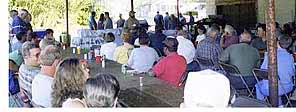 So the Project participants contacted Bob Carter, District Conservationist with the NRCS in Henderson County. Carter is responsible for implementation of EQIP, providing cost-share opportunities to growers and landowners that implement practices addressing local environmental problems. Historically, most of the EQIP funds in the County were dedicated to minimizing sediment loss from agricultural fields. But Carter said, "When I heard about the IPM Project’s goals to reduce pesticide use, I was immediately interested. In this part of the state, pesticide use in agriculture and forestry is associated with significant water quality problems. It made sense to me that IPM adoption could help."
Carter developed an IPM practice that could be cost-shared under EQIP. This practice, first offered in 2001, now has close to 40 grower-participants. In order to participate, growers must hire a qualified scout to visit their orchards, on a weekly basis, throughout the growing season. Growers receive $22.50 per acre—roughly 75 percent of the average cost of hiring a scout. The scout provides written records and recommendations for pest management. In addition, scouts conduct soil tests and leaf tissue analyses for fertility management, and make recommendations for both weed and vole management. By collecting and synthesizing enough information about orchard conditions, including the numbers of both pests and beneficial organisms, growers only have to apply pesticides when absolutely necessary. Notes Gene Klimstra, independent area scout, "There’s no doubt that when a grower hires a scout for the first time and bases his spray decisions on what’s really going on in the orchard, pesticide use and costs go down."
Close to 2,000 acres of apple orchards in Henderson County are now cost-shared under EQIP. This represents over 35 percent of the total apple-acreage in the County. At least part of the enthusiastic response from growers is that most of the paperwork is taken care of by scouts, because scouts are responsible for submitting records and invoices to NRCS. According to Greg Nix, local apple grower and packer, "I really like the program. It helps me make sure I am operating the most efficient and effective pest management program I can. And on top of that, there is minimal paperwork, which for me is a major plus."
More growers are interested in the program but funding is limited. In fact, in the past year, only one grower was accepted. This was largely due to changes in state-level management of the EQIP program. Notes Carter, "This past year, our program has had to adjust to new rules provided under the recent Farm Bill. Because of delays, priorities for cost-share were established at the state level rather than at the local level. In that context, it’s hard for pesticide-related water quality problems to compete against the massive nutrient-related problems in the eastern part of our state. So we had very little funding for pest management this year."
Carter remains hopeful that local priorities will reassert themselves and additional funding will be made available next year. In the meantime, western North Carolina’s IPM cost-sharing practice in apple production is a shining example of EQIP’s ability to meet the unique conservation and production needs of fruit and vegetable growers.
Putting the Farm Bill to Work Quick Links
- Appalachian Region
- California
- Georgia
- Michigan
- North Carolina
- North Carolina Apple Growers
- North Carolina Nursery Crops
- North Carolina Christmas Trees
- North Carolina Strawberry Growers
- North Carolina Strawberry Survey
- North Carolina Sweetpotato Producers
- North Carolina Sweetpotato Survey Summary
- Western North Carolina Vegetable Growers
- Oregon