EQIP Money Helps Growers Fund Useful Practices, Including IPM
by Dick Lehnert
 Fruit and vegetable growers have a unique opportunity to adopt innovative practices—with part of the cost picked up by the federal government. To qualify, the practices must address resource conservation. The good news is many fruit and vegetable production practices such as integrated pest management can enhance resource conservation so growers can put together a strong application for these federal programs. The government is also reaching out to encourage more specialty crop growers to apply.
The encouragement comes from EQIP, the Environmental Quality Incentive Program first implemented under the 1996 Farm Bill. Funding was beefed up under the 2002 bill. Last year, about $13 million came to Michigan and about the same is expected this year.
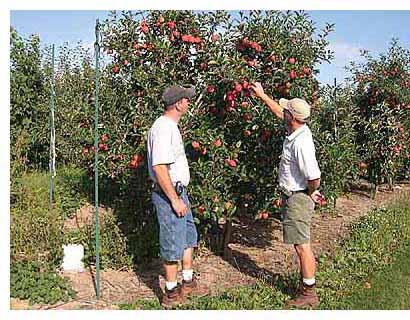
At Altonen Orchards near Elk Rapids, John and Brian Altonen signed an EQIP contract to build three agrichemical containment facilities (one at each of their widely separated farm locations) and to implement practices such as installing sod centers for erosion control and mulching trees as part of a nutrient management plan.
At Todd Greiner's farm near Hart, Todd signed on to install a grassed waterway, travel lanes, a windbreak, a spray building and IPM practices.
In both cases, the local Natural Resources Conservation Service (NRCS) District Conservationists played large roles in helping them participate.
 Brian Altonen credits Pepper Bromelmeier, the NRCS District Conservationist in Antrim and Kalkaska Counties, who admits to being a strong advocate for "her farmers" and working hard to find ways to help them qualify.
"It's tough to get a contract now with just one practice," she said. Fruit and vegetable farmers compete with livestock producers who want to build manure containment facilities or put in fence and water for grazing systems and with crop producers who want to change tillage systems. But because horticulture is so complex, there are lots of ways to accumulate the points needed for a successful application. Bromelmeier makes sure her clients know all their options for point-building practices.
In the same way, Todd worked with Oceana County NRCS District Conservationist Mark Kelly. Kelly walked Todd's 400-acre farm and pointed out where EQIP-funded projects would apply.
The Altonens were already well along on adopting IPM practices, which are a good source of points. Eight years ago, they hired an IPM scout, Mark Doherty with HortSystems, Inc., who traps to identify pests, monitors weather information on growing degree days and wetting periods and recommends when to spray and what are the least-damaging spray materials for pest control. The Altonens use two Smart Sprayers that sense presence and absence of foliage and turns spray nozzles on and off accordingly.
Mark sits on the foundation board at the Northwest Michigan Horticulture Research Station and feels a high degree of "ownership" of Michigan State University's weather monitoring system. He uses web sites like MIfruit.com and PestNet, which keep growers informed about wetting periods that affect scab and fireblight and growing degree days that mirror insect development.
 Still, together, Doherty and Bromelmeier found new things Altonen Orchards could try, much of it based on research by MSU specialists and the staff at the Northwest Michigan Horticultural Research Station.
Sod centers composed of mixed grasses and legumes are a practice EQIP pays for. Not only do sod alleys reduce soil erosion, they provide habitat for beneficial mites and insects and trap and release nutrients. Legumes in the mix produce nitrogen that benefits the grass without the need for added N fertilizer.
As a part of a "Pest Management" plan, producers can mulch their trees. Mulch suppresses weeds that would otherwise require herbicide applications and can be managed as part of a nutrition program using slow-release materials. The mulch the Altonens put down was legume hay, which is richer in nutrients than straw or wood chips. As the legumes break down, they provide additional nutrients to the trees.
Mating disruption is a practice EQIP encourages because pheromones have less impact on the environment than pesticides for insect control.
 "I appreciate Pepper's approach," Brian said. "She has the attitude, ‘How can I help you qualify?' and suggests new things. I can guarantee you, if I had to do the paperwork by myself this building wouldn't be here now." We were all standing in a new 40- x 40-foot pesticide containment facility, which has a bowl-shaped concrete floor coated with an epoxy sealant and a concrete trench in the center covered by a grate. In the event of a pesticide spill while filling a sprayer or moving a container, all the spilled material can be recovered—rather than contaminating a well or percolating though the soil and into groundwater.
EQIP contracts can be for up to 3 years and offer financial incentives often at 50 percent of the cost to implement. The Altonens have more than 300 acres of fruit and vegetables and maintain a roadside market for about a third of their sales. They raise squash, pumpkins, asparagus and strawberries, and tree fruits include sweet and tart cherries, peaches, apricots, plums, pears and more than 20 varieties of apples. Some of their fruit is sold to Gerber Products.
Greiner's 400 acres include 125 of asparagus plus sweet and tart cherries, peaches, pumpkins and evergreens. He says he's wanted to do more scouting and "really needed the spray shed." It only takes one unguarded moment to overfill a sprayer and contaminate the ground with pesticide.
Working with Kelly, Greiner devised a plan that included:
- A grassed waterway for an eroding hillside with seeps that need to be shaped, drained and seeded.
- A windbreak of Imperial Carolina poplar to improve pollination in a young orchard and shield fruit from bruising.
- Travel lanes in three areas that were steep and eroding and that needed to be reshaped and graveled.
- IPM practices that would be carried out by a scout who will monitor fruit and vegetables to improve timing of spray applications for insects, diseases and weeds.
- A spray building, called an ACF or agrichemical containment facility with a floor designed to hold 750 gallons as "secondary containment" if a first container, the sprayer or pesticide tank, is damaged or overflows. "It also provides a safe place to power wash the sprayer so the wash water can be recovered with a sump pump and properly disposed of away from the well," Kelly said.
While Kelly worked closely with Greiner in developing the EQIP plan, it was Greiner who made the first move. "We had a public meeting sponsored by MSU Extension on EQIP last winter and about 20 farmers showed up," Kelly said. "He indicated his interest. We made an appointment. I visited his farm and the plan evolved from there."
Resources for more information
For more information on production and environmental benefits of using IPM on your farm and how EQIP and other conservation programs may assist, visit these websites: www.canr.msu.edu/farm_bill/ and www.agcenter.org.
To locate your nearest NRCS office, go to: https://www.nrcs.usda.gov/. Click on "find a service center" on the left side of the screen.
For assistance with IPM and related production practices, contact your local MSU Extension educator.
Putting the Farm Bill to Work Quick Links
- Appalachian Region
- California
- Georgia
- Michigan
- North Carolina
- North Carolina Apple Growers
- North Carolina Nursery Crops
- North Carolina Christmas Trees
- North Carolina Strawberry Growers
- North Carolina Strawberry Survey
- North Carolina Sweetpotato Producers
- North Carolina Sweetpotato Survey Summary
- Western North Carolina Vegetable Growers
- Oregon