Peanut Program in North Carolina and Virginia
Integrated Pest Management Tool
As the 2002 Farm Bill made dramatic changes to the peanut program, North Carolina peanut growers have faced increasingly difficult economics. Each year, farmers are seriously weighing how much peanut acreage to plant or whether to raise peanuts at all. Of those who decide to grow, some say maximizing yield is the best path to profitability. Others seek ways to increase efficiency, particularly from production inputs—and for these growers, reducing pesticide costs is an important tool in the quest for profitability. This is where adoption of the Southern Corn Rootworm (SCR) Index is helping, driven by a marketing-oriented communication approach.
Peanut farmers consider the southern corn rootworm (SCR: Diabrotica undecimpunctata howardii) the most serious soil-borne insect pest. Adults emerge from cornfields during June/July and feed on the foliage of flowering peanut plants but seldom cause economic problems. However, the immature insects are subterranean feeders, they directly damage roots and fruiting structures. Their feeding damages pods and/or allows the entry of soil pathogens. This increases the possibility of aflatoxin contamination. Cosmetic damage also causes economic loss because large-shell peanuts are sold primarily in the shell in grocery stores or ballparks.
The Index gives growers a way to score their fields on risk factors such as soil type and moisture to determine the risk of rootworm damage to individual crops. Based on risk scores, growers can decide whether or not to use a soil-applied insecticide for control. The SCR Index provides a validated scientific model growers can use instead of customary pest management practices.
But despite its value in peanut production, growers were not widely adopting the SCR Index by the end of 2002. In fact, less than 10 percent were using it to make decisions in controlling SCR. The Center for Agricultural Partnerships (CAP) and North Carolina State University (NCSU) responded to this problem by taking a marketing-oriented approach that gave Extension agents tools for working directly with growers to promote and begin using the SCR Index. This work built on results from a project with NCSU and Virginia Polytechnic Institute (VPI) to validate the Index.
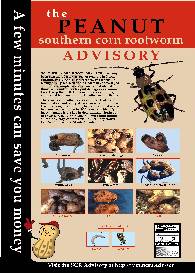
Project staff developed a revamped brochure, a poster on the SCR Advisory, a laminated card showing SCR and other insect damage, and baseball caps—all unified by the newly developed Advisory logo. These materials were created based on input by Extension agents from all peanut growing counties in Eastern North Carolina.
In January 2003, the agents used the materials at the winter grower meetings to raise awareness and emphasize the value and ease of using the Advisory. Of particular importance to the agents was the opportunity to meet and work directly with growers one-on-one. They felt that doing so would be the most effective way to familiarize growers with the value of the tool. The agents identified 20 peanut growers not using the SCR Advisory and worked one-on-one with them to promote the use of the Advisory, implement it and evaluate results post harvest. A crop consultant was involved as well.
Results highlights
 Extension agents and the consultant worked with 143 growers to use the SCR Advisory to score 608 fields as low, moderate or high risk. Growers who had low-risk fields and did not apply insecticides expressed confidence in the tool and an interest in saving money. Those who treated low-risk fields most often cited the extremely wet 2003 growing seasons as the reason. Other reasons such risk aversion and the convenience of treating all the fields were also cited.
Growers were surveyed on their awareness of and confidence in the Advisory. Of the growers surveyed, those who had not heard or read about the SCR Advisory dropped from 37 percent to 12 percent between 2003 and 2004. For the same period, growers who had heard or read about the Advisory two to five times grew from 45 percent to 63 percent. Those who consider the Advisory effective for managing SCR also increased—from 40 percent to 63 percent. And by 2004, growers who said the use of the SCR Advisory contributed to their using less pesticide had grown to 27 percent.
With the exception of Edgecombe County, where insecticides generally are not used for SCR control, 76 percent of the growers said they intended to use the SCR Advisory next year. This willingness to use the Advisory in the future was the most important indicator of its value and the success of the project. It shows that the vast majority of participating growers are willing to consider field information in making decisions whether to use an insecticide.
The Agents and a great majority of growers considered the Advisory a sound tool for assessing insecticide and potentially cutting input costs.
The Extension Agents were asked if the project's approach to working with growers was effective. The uniform response was "yes." According to the agents, the opportunity to work directly with growers was particularly effective, as indicated by their comments:
"This had to be a hands-on, on-the-farm project to show growers that the Advisory works."
"Sometimes it's just better to talk with people face-to-face and put the Advisory in their hands. Meetings and newsletters are just not the same as saying, ‘Let's look at your fields and use the Advisory and see where your fields fall.’ This approach involved the agent on a one-on-one basis and I think that's the way to go: It was good, gave us options for getting us involved as we felt necessary. The project did more than just putting information out there and just letting growers use it if they wanted."
Conclusions
Awareness and acceptance to the Advisory clearly increased during the project. This was driven by the innovative marketing-oriented approach of targeting Extension agents, who influence adoption through individual contact with growers.
In applying less pesticide than in previous years, growers had made more sophisticated decisions based on scientific observations. This is a significant step forward. What’s more, the confidence of the agents provides a solid long-term basis for extending grower use in coming years.
Overall, the approach has significant potential for increasing adoption of practices that help reduce environmental risks.
 For more information, contact
- Dr. Mike Linker
- CALS IPM Coordinator
- Crop Science Department
- North Carolina State University
- Box 7620, Raleigh, NC 27695-7620
- (919) 515-5644 phone
- (919) 515-5315 fax
- mike_linker@ncsu.edu
Link for the full report in PDF format: https://www.agcenter.org/EPAFinal%20Project%20Report6.04.pdf
Visit this website, created by Virginia Tech, to view a web-based version of the risk index http://www.isis.vt.edu/cgi-bin/scrRisk
- North Carolina State University
- Virginia Tech
- Independent crop consultants
- Peanut farmers in North Carolina and Virginia