North Carolina Neuse Crop Management Project
Weed IPM and Nutrient Management in the Neuse River Basin
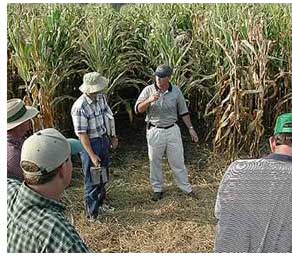 The Neuse River Basin drains 1.2 million acres in central and eastern North Carolina (NC), including rapidly growing metropolitan areas, productive farmland, and extensive forests. The Neuse River Estuary has experienced harmful algae blooms and fish kills over the past two decades, resulting in state regulations that mandate a 30% reduction in annual nitrogen loading from all sources by 2003. Agricultural land uses throughout the river basin are estimated to contribute more than half of the total nitrogen load to the estuary, meaning that farmers are responsible for implementing best management practices that reduce nitrogen export by over 1 million pounds annually. At the same time, pesticides used in the region are under intense scrutiny by the US Environmental Protection Agency as it implements the Food Quality Protection Act.
The Neuse Crop Management Project was initiated in 1998 with the goal of increasing the use of production practices that improve the economic, agronomic, and environmental performance of corn/cotton/wheat/soybean farmers in the Neuse River Basin. The project established an unprecedented partnership among farmers, crop consultants, agribusinesses, grower organizations and NC State University research and extension to reduce unnecessary nitrogen and herbicide use and losses, thereby protecting water resources in the Neuse River Basin.
Specific accomplishments include:
- more than 105,000 acres of nutrient management plans written and implemented;
- a 23% reduction in the amount of fertilizer nitrogen applied per acre of cropland; and
- a greater than 40% reduction in soil-applied preemergence herbicides;
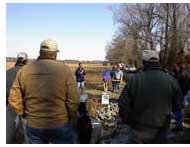 Nutrient management training materials were developed and distributed to NC Cooperative Extension Service county agents, who then educated farmers about nutrients in the environment, how best management practices reduce nutrients, nutrient management planning and eight crop commodity modules. In 2001 and 2002, nutrient management training was offered throughout the Neuse River Basin to 1,240 farmers and turf managers.
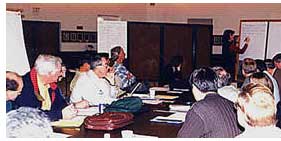
To meet the challenge of developing nutrient management plans for thousand of acres, project personnel developed two innovative approaches. A simplified computerized nitrogen fertilizer spreadsheet was developed for commercial fertilizer plans. In addition, group nutrient management planning sessions were introduced. The farmers brought field information and project personnel worked with the farmers to write nutrient management plans. Two cost-benefit analyses were conducted during the life of this project. One analysis was for the best management practices, such as controlled drainage, cover crops and buffers, and the other was for nutrient management. The nutrient management cost-benefit study found that many farmers can save $20-40 per acre of cropland by using nutrient management. The best management practice cost-benefit analysis found that the benefit of the best management practices was highly dependent on the practice and the physiographic region.
 To help producers make better herbicide use choices, and thus reduce preemergent soil-applied herbicides, the project selected to use a computer-based decision support system called HADSS (Herbicide Application Decision Support System) that allows farmers, commodity specialists, or crop consultants to determine the most cost-effective, environmentally sensitive, and effective herbicide. By making decisions on a field-by-field basis (termed site-specific), more precise selection of herbicides, application rates, timing, and placement of weed control measures are possible, and can minimize the application of unnecessary or inappropriate herbicide treatments. During the project, however, the weed control situation changed dramatically when Roundup Ready technology was introduced to NC farmers. Growers quickly embraced the Roundup Ready system for cotton and soybeans. In 2002 over 90% of the soybean acreage and upwards of 60% of the cotton acreage are in Roundup Ready varieties. Using acreage data on corn and shifts into Roundup Ready varieties, one can conservatively estimate a 40% decrease in the use of soil-applied preemergence herbicides. The rapid acceptance and increase in soybean and cotton acreage of Roundup Ready crops has dramatically accelerated the reduction in soil-applied preemergence herbicides.
The Neuse Crop Management project demonstrated that nitrogen management is an effective and cost-efficient means for controlling nonpoint source nitrogen from agricultural sources. Before the project, many producers used their soil tests for lime, not phosphorus, and they applied nitrogen at standard rates. Two-thirds of the participating growers reported that they decreased their nitrogen application rates as a result of project recommendations. Some examples of estimated nitrogen rate reductions due to the project are 15 to 20% on cotton, 14 to 28% on corn, 15 to 24% on tobacco, and 4 to 20% on wheat. One farmer stated, "The project helped us think through what we were doing and not just apply fertilizer according to tradition, which is how a lot of us farmers work."
 The project's success was based on a unique set of circumstances: the existence of the Neuse Education Team and the many other agencies and organizations working in the Neuse River Basin; the extensive consultation and feasibility study at the beginning of the project which led to the creation of strong working relationships that made the project successful on a very significant scale; the ability to obtain funding from multiple sources; a highly competent staff; the multidisciplinary, multiagency, and multipartner nature of the project structure; the willingness of the farmers to be part of the solution, having project technicians that allowed intensive, one-on-one work with growers; an egalitarian structure that allowed staff to make decisions and do their work relatively independently; and the regulatory pressures for nitrogen reduction.
One of the project's advisory board members, who is also a farmer, summarized the project, "This project provides an opportunity for farmers to provide leadership in implementing solutions to solve regional problems" – Charles Alexander, Pamlico County producer.
For more information, contact;
- Deanna Osmond
- Project Manager
- Soils Extension Specialist
- North Carolina State University
- E mail: deanna_osmond@ncsu.edu
- Website: NCSU Neuse Project Website
View the Press Release (PDF file size approx. 105K)