Central Coast Vegetable IPM Project (CCVIPM) (1997-2001)
Intensive Insect Management on Lettuce and Celery Crops, California
The $1.6 billion-a-year lettuce and celery industry along California's Central Coast, which accounts for 60 percent of the nation's supply, faces insect problems that no individual grower or pest control advisor (PCA) can solve alone.
This project set out to develop and evaluate an environmentally friendly, economically viable, pest management approach to the pea leafminer, Liriomyza huidobrensis, which attacks young celery and lettuce plants. Then the project shifted gears to deal with the critical problems emerging from the appearance of a new pest, the lettuce aphid, Nasonovia ribis-nigri. The goal of this project was to control the insects more effectively by refining, validating and sharing a commercial-scale integrated pest management system that can be adopted by a high percentage of the coastal lettuce and celery industry.
 The summer and fall outbreaks of the pea leafminer can produce 10 to 15 million larvae per acre. The hatching pea leafminers burrow deep in the heart of the developing lettuce and celery, feasting on tender, young plants and depositing a brown "mining" trail of damage as the pests work their way through the plant. In 1999 Salinas Valley growers discovered the lettuce aphid, a heretofore-unknown pest, invading their 115,000 acres of lettuce and celery fields. The aphid infests the base of the lettuce leaf, making the insect difficult to control and the product unacceptable in the marketplace. The remarkably persistent aphid resists control by most conventional pesticides.
At best, growers lose productivity when they're forced to strip away damaged leaves and stalks. At worst, entire fields are so damaged that they never make it to harvest. The explosion of the pea leafminer and the lettuce aphid is literally eating into gross revenues of $5,000 to $6,000 per acre for lettuce and $8,000 to $9,000 per acre for celery. At the same time, pesticide costs have nearly doubled in the past four years, reaching as much as $800 per acre. And the pesticides are not coming close to containing the crop damage. The pests weaken and stunt the growth and cause leaves and stalks to be discarded during harvest. These pest infestations have increased the number of pesticide applications, the number of chemicals used, and the cost of pest management--without achieving intended levels of control.
By using a team approach of sharing more accurate information about the leafminer and the aphid, and by agreeing on a set of consistent and team-validated pest management strategies, the new decision-making system developed by this project has allowed PCAs and their growers to take advantage of a full range of pest control techniques. The project published a picture guide to pest and beneficial insects and developed a website, http://ccvipmp.ucdavis.edu, which posts newsletters, trial protocols, insect photos, and data from the demonstration plots.
The CCVIPM Pesticide Treatment Menu Guidelines were:
| Standard |
IPM |
| All
registered classes: organophosphates, carbamates, and pyrethroids
included. |
Excludes
organophosphates, carbamates, and pyrethroids when alternative
registered chemistry is available. |
| Includes
all classes of registered biologicals. |
Emphasis
on using biologically based materials. Conservation of natural enemies. |
| Leafminer
adulticides. |
No
leafminer adulticides. |
| A
typical spray regime. |
A
post-FQPA scenario? |
More than 20 growers participated in the project, using the experimental pest control program on 46 field demonstrations covering 667 acres. These included 29 head lettuce, 10 romaine, and 7 celery fields from Watsonville to Oxnard. 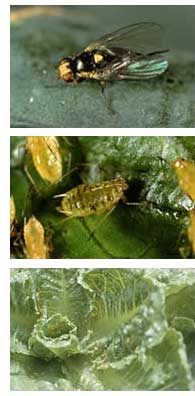 This acreage conservatively represented a risked investment of $2 million. In these fields, the reduction in the number of applications of organophosphates, carbamates, and pyrethroids for the IPM treatments compared to the standard was 87 percent for head lettuce, 88 percent for romaine, and 72 percent for celery.
The switch to the use of the IPM treatments had little effect on harvest quality or quantity. There was no significant difference in yield for romaine or celery. In head lettuce, 12 percent of the replicated field trials had significantly higher yield from the IPM treatment. However, many of the "softer" IPM materials are more expensive than older OPs, carbamates, or pyrethroids. Thus there was a higher cost for the IPM treatments, up to $0.08 per carton higher. This project has changed the way chemicals are used to control the pest complex, thus reducing reliance on Food Quality Protection Act (FQPA)-targeted insecticides and increasing the use of natural enemies. However, eliminating FQPA-targeted materials is not possible at this time. One or more of the excluded pesticides was used on the IPM treatment in 38 percent of the head lettuce, 29 percent of the romaine, and 100 percent of the celery trials.
Together, the vegetable companies partnering on this project grow and ship about one third of the lettuce and celery in California's Central Coast region, which itself accounts for 60 percent of the nation's supply. The changes in decision-making skills among the companies and their cooperation in the project have not only improved their ability to handle difficult pests, it has also yielded a 30 percent reduction in organophosphate use and the overall reduction in the number of OP applications over all fields was 82 percent.
Salinas Valley's four major vegetable companies and industry leaders:
- Dole Fresh Vegetables
- Tanimura & Antle, Inc.
- D'Arrigo Bros. Co.
- Duda California/Gene Jackson Farms, Inc.
Commodity boards:
- the Lettuce Research Board
- the California Celery Research Board
Input suppliers:
- Western Farm Service and Soilserv, Inc.
- University of California Cooperative Extension Farm Advisor in Monterey County