Michigan Apple IPM Implementation Project (1998-2001)
Integrated Fruit Management in Michigan Apples
Using a common system of monitoring, the project staff developed the infrastructure to carry out large-scale scouting and implementation efforts by training current growers and their employees, consulting firms, and agri-chemical firms in the use of the new information-intensive systems.
In 1999 orchard insecticide use among the project's growers was reduced 49 percent through the use of mating disruption on 877 acres and net revenues were higher in the Integrated Pest Management (IPM) orchards because of better control and higher fruit quality.
In the 2000 growing season, the project expanded to 2,833 acres with 63 growers despite extremely difficult growing conditions and low prices to growers. Total organophosphate reduction in selective blocks, that year, was 26 percent. Again, growers netted higher revenues through better control, higher quality fruit, and an average insecticide cost savings of $48/acre.
In 2001 project participation, projected at 8,000 acres, rose to 8,360 acres. One hundred and three growers participated in this project last year, and in three years the project has achieved an overall average reduction of organophosphates of 35 percent.
Growers were from the following regions in Michigan:
| Region |
#
of Participating Growers |
Participating
Orchard Acreage |
| South East | 25
|
594 |
| South West | 32
|
1,439 |
| Fruit Ridge | 105
|
7,611 |
| West Central | 26
|
926 |
| Northwest | 24
|
1,506 |
Economic Analysis: Estimated Net Costs* Per-Acre for Mating Disruption Programs
| Pheromone** used for moth mating disruption in Selective Programs | 1999
Growing Season |
2000
Growing Season |
2001
Growing Season |
||||||||
| #
Farms |
Selective
Programs |
Comparison
Programs |
#
Farms |
Selective
Programs |
Comparison
Programs |
#
Farms |
Selective
Programs |
Comparison
Programs |
|||
| Isomate C Plus | 10 |
$134.20 |
$132.14 |
11 |
$151.23 |
$160.93 |
14 |
$164.03 |
$196.07 |
||
| Isomate CM/LR | 7 |
$266.95 |
$241.00 |
13 |
$256.38 |
$264.75 |
17 |
$271.71 |
$245.63 |
||
| MEC-LR | 8 |
$180.59 |
$205.95 |
8 |
$211.92 |
$246.16 |
7 |
$178.38 |
$180.06 |
||
*
The figures here total the cost of pheromone dispensers,
cost of labor for placement, and an estimated loss of profit
based on fruit injury sampling.
**Click
here for a description of pheromones used.
Communications
Average annual expenditures on insecticides and miticides used in selective block ranged between $26.60 and $41.48 per acre greater than comparison blocks. In general when revenue loss from fruit injury was factored into this equation, the selective block were more economical (i.e. total expenditures were less) than comparison block only when the percentage of fruit being sent to a fresh market (as opposed to processing apples) was near 100 percent. One conclusion of the economic analysis is that incorporating mating disruption into a selective pest management program can be done economically, particularly when a high percentage of the fruit is targeted to a fresh market.
 The economic viability of mating disruption programs can also be enhanced by eliminating the need for pesticide applications for secondary pests (i.e. mites, aphids, and leafminers) because unlike broad-spectrum pesticides, mating disruption does not reduce or eliminate natural enemies. Elimination of a single miticide application can result in savings of $40-$50 per acre, a large portion of the cost of the mating disruption programs used in this project.
For more information, contact
- David Epstein
- Project Coordinator
- 517-432-4766
- epstei10@msu.edu
The Michigan Apple Implementation Project website is: http://www.cips.msu.edu/maipmip/
View the Final Report (file size: approx 1.5 MB)
Educational Materials
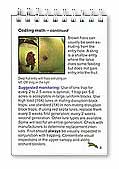 Scouting Guide
In the spring of 2000, the Michigan Apple IPM Implementation Project (MAIPMIP) produced a 68-page apple pest guide that can be used by growers in the field. The full-color booklet is small enough to fit in a large pocket, and the spiral-bound pages are printed on plastic-coated paper to resist wrinkling, water, and dirt.
 Fact Sheets
The project produced fact sheets on key pests in Michigan apple orchards, including codling moth and oblique-banded leafroller.
A special edition of the Gerber IPM Newsletter was used to promote industry-wide awareness and implementation.
- Gerber Food Products
- The Michigan Apple Committee
- Michigan IPM Alliance
- Michigan State University
- Growers
- Consultants