[National Grape Cooperative, Inc.]
Scouting Boosts Confidence and Control for Grape Growers
The National Grape Cooperative and Michigan State University IPM research-extension programs implemented a grape IPM scouting project with growers in southwest Michigan. The long-term goal was to create a program that could be adopted widely in grape production in Michigan and across the eastern U.S. to improve the economics and environmental impact of grape production.
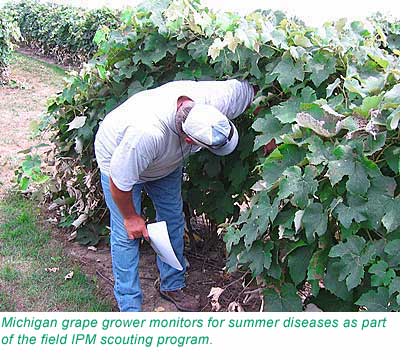
At program launch, the pesticide application patterns of many Michigan grape growers were not based on regular vineyard-specific scouting. Fourteen growers agreed to participate in this pilot. In early spring 2005 they received materials and advice to help them with scouting, identifying pests, monitoring results and recording data.
With the price of juice grapes down considerably, growers are facing tough economic times. Any perceived risk from a change in practice is hard for growers to assume under such conditions. "Those outside of the process who think that scouting is a no-brainer need to understand that the perceived risk is great in moving from what has worked in the past to what might work," said Davenport. "It has to be fully demonstrated to get growers to change."
"Most seemed willing to spend the extra hour per week required to do the scouting," said Dr. Rufus Isaacs of Michigan State University’s Department of Entomology, project manager. The grape growers, who collectively farm 1300 acres of vineyards each, scouted an average of 20 acres of their farms each week, taking 1-1.5 hours. Eighty six percent of these growers said it was beneficial to scout their own acreage for pests. Because of the additional information they had about their farms and the level of insect and disease pressure, up to four pesticide applications were saved, with an average of 1.1 fungicides (2005 was a dry summer in Michigan) and 0.7 insecticides per acre. The products that were saved differed from farm to farm, but were all broad spectrum insecticides and fungicides. All but one of the growers planned to continue scouting. That other grower planned to hire a crop consultant to regularly scout his vineyards.
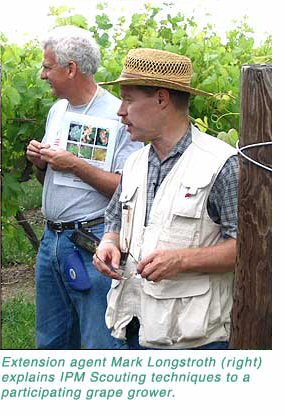 The transfer of knowledge to growers and their application of it on their own farms worked very well. "We had a high rate of adoption of the scouting sheet that was developed," said Isaacs. Growers could see the importance of regular vineyard checks for pests, and how that helped to minimize costs without sacrificing quality. One grower stated, "It’s [scouting] allowed me to get into habits that I was neglecting to do. I realized that it wasn’t as big of a chore as I thought it might be. I think it was well worth it." In spring 2006, one of the participants detected an unusually early insect infestation. Had he not scouted his orchard, he would have missed the infestation.
The confidence issue is critical. "You can’t always put things in dollars and cents," said Thomas Davenport, director of viticultural research and regulatory compliance for the National Grape Cooperative. "There are long-term financial benefits, but the big short-term gain is confidence building," he said.
"The hands-on IPM scouting education coupled with the commitment to regularly check their own vineyards can be a powerful tool to help growers remain profitable in the grape market where profit margins continue to shrink," stated Isaacs. Overall this project helped the grape industry remain profitable and has helped individual growers who adopt these practices, stay in business through difficult economic times, while also reducing the environmental impact of grape production.
For more information please click: www.grapes.msu.edu.
CLICK HERE for a copy of Working from the Ground Up (PDF -992K).