[Parrot Jungle Island]
Zoological Theme Park Developing Protocols for Worldwide Application
In Florida, the task was to implement and evaluate the effectiveness of six safer alternative pesticides to control mosquitoes on the Parrot Jungle Island park in Miami. The effort included using four biochemical products. The big-picture goal is to apply the findings of the project to other park facilities like Parrot Jungle Island (PJI) that must control mosquito populations.
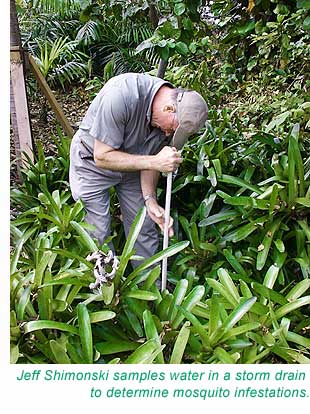 Aerial spraying and fogging have historically been the main method of control. Spraying raises issues though, the first being phytotoxicity. In layman’s terms, spraying pesticides can cause significant burning on new plant growth. Second, it can cause the loss of beneficial or non-target insects. "Insect predators are critical components in integrated pest management (IPM) and plant health care programs," said project manager, Jeff Shimonski, the Director of Horticulture for PJI.
The solution is mosquito larvae control. The initial premise was to control the larvae that were breeding in the natural water bodies (phytotelmata) found in the thousands of bromeliads that were grown as ornamental plants throughout the 18 acre site of Parrot Jungle Island in Miami, Florida. The larvae were sampled on a weekly basis, identified as to the species, and then control was attempted with the use of six biochemicals. The testing of these biochemicals would show that substantial control could be achieved with chemicals that were safe to use on the bromeliads, that they were not phytotoxic, and they would be safe to broadcast into the environment without harming other animals and insects.
It soon became apparent that the storm drains, not the bromeliads, were the main source of mosquitoes that bred in the park. An identical mosquito larvae sampling program for the 20 storm drains within the park boundaries was developed alongside the bromeliad sampling program.
"The project demonstrated that substantial control of adult mosquitoes could be achieved in an 18 acre park through safe, environmentally sound methods," states Shimonski. The same results were achieved with both sampling programs, that is, three of the biochemicals either individually or mixed with another eradicated the larvae from both the bromeliads and the storm drains.
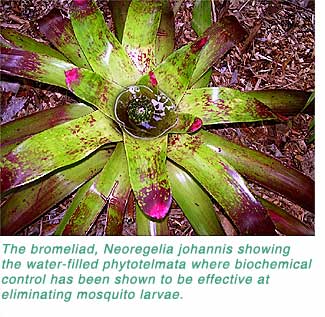 The best measurement of the success of this project is that aerial adulticiding was stopped at the end of August 2005 after years of spraying the park at least once a day, nearly every day of the year, regardless of the season or the amount of local rainfall.
A small number of the storm drains had been initially treated for larvae control and then for months afterwards, mosquito larvae were either never collected from the drains again or where too few in number to bother. Occasionally tadpoles or damselfly larvae would be spotted inside the drains while sampling but never in large enough quantities that would control the mosquito larvae.
This project and its documentation will continue at the park. A similar mosquito larvae control project at a different and larger (60 acres) facility further inland has begun in the hope of working with different species of mosquitoes in different situations.
Signage is also being created that will be placed permanently in the park to explain how this mosquito larvae control program compliments the Integrated Pest Management program. This information will then be accessible to over 400,000 park visitors a year with over 100,000 of them being school children.
For more information please see: http://tropicaldesigns.com/ipm.htm.
CLICK HERE for a copy of Working from the Ground Up (PDF -992K).