[Wisconsin Apple Growers]
Apple Growers Work With EQIP
Project opens new opportunities for growers to use IPM through conservation programs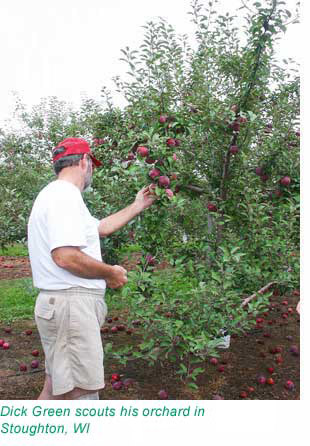 The Wisconsin Apple Growers Association is facilitating wide grower adoption of strong IPM programs. The project focused on providing technical and financial assistance to 28 growers for scouting their orchards through the Environmental Quality Incentives Program (EQIP). In addition to the field scouting, the project involved collaboration with the Natural Resources Conservation Service in refining opportunities to support an integrated orchard management program.
"Everything has gone pretty much as planned," says Michelle Miller, IPM program manager with the University of Wisconsin-Madison Center For Integrated Agricultural Systems. "We’ve taken a lot of time to make EQIP work for apple growers."
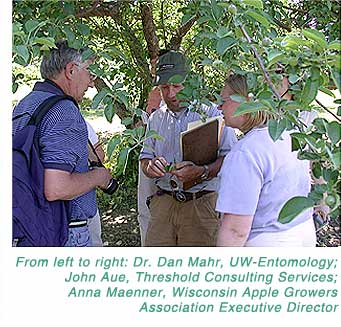
"The main thing at the start is to get growers to start thinking about IPM in an organized way," said John Aue, an IPM consultant and etymologist involved in the project at the field level. "Most of these guys are already pretty knowledgeable about IPM. They simply need someone like me to push them in a direction they may have already gone in at a certain level, such as new chemistries, trapping insects, monitoring weather and keeping records," he said. "Every one of these growers is interested, and having a coach available through EQIP is a real boon."
Similar reductions in pesticide risk with these growers to the eco-apple growers experience are anticipated (58% pesticide risk reduction in two years). The project team supported 13 growers with federal contracts in 2005 (~870 acres) and another 14 contracts (~702 acres) in 2006. We secured double the money for growers in 2006. All the eco-apple growers also benefited from the project (about 40) so the project benefited a number of growers.
Coaching growers at the orchard level is key. "Many growers are commited to reducing pesticides and have innovative ideas for ways to do it. With a little coaching and support, especially in how to collect data and anlyze it, they are better positioned to take the risks inherent in changing their management appraoch to include a pesticide-reduction goal," states Miller. The project was able to identify that specific resource constraint as pivotal. "Without this additional support the participants would have been unable to pursue federal conservation program money for 2006 and beyond. CAP helped stabilize this volatile effort so that it could gain necessary foothold and forward momentum."
 Implementation of robust IPM programs is completely reliant on one-on-one coaching for its success, but finding adequate field support for that work has been challenging in Wisconsin where orchards are widely distributed in the state. Just as important a comprehensive, effective program must also be relatively easy for NRCS to administer within existing programs. It is estimated that about $1.1 million would be necessary at the orchard level to move WI apple growers from a phenology-based pest management approach to a data-based management approach.
The bottom line is that EQIP works well when adapted to fit the conservation opportunities available for Wisconsin apple growers. "As the program progresses, it will be important to make a bigger effort to bring EQIP growers into the farmer networks and to strengthen the relationships with NRCS staff at the county and state level." If that effort succeeds more growers will be able to increase their use of IPM and to implement permanent pesticide risk reduction in their orchards.
For more information please see: www.ThinkIPM.org
CLICK HERE for a copy of Working from the Ground Up (PDF -992K).